

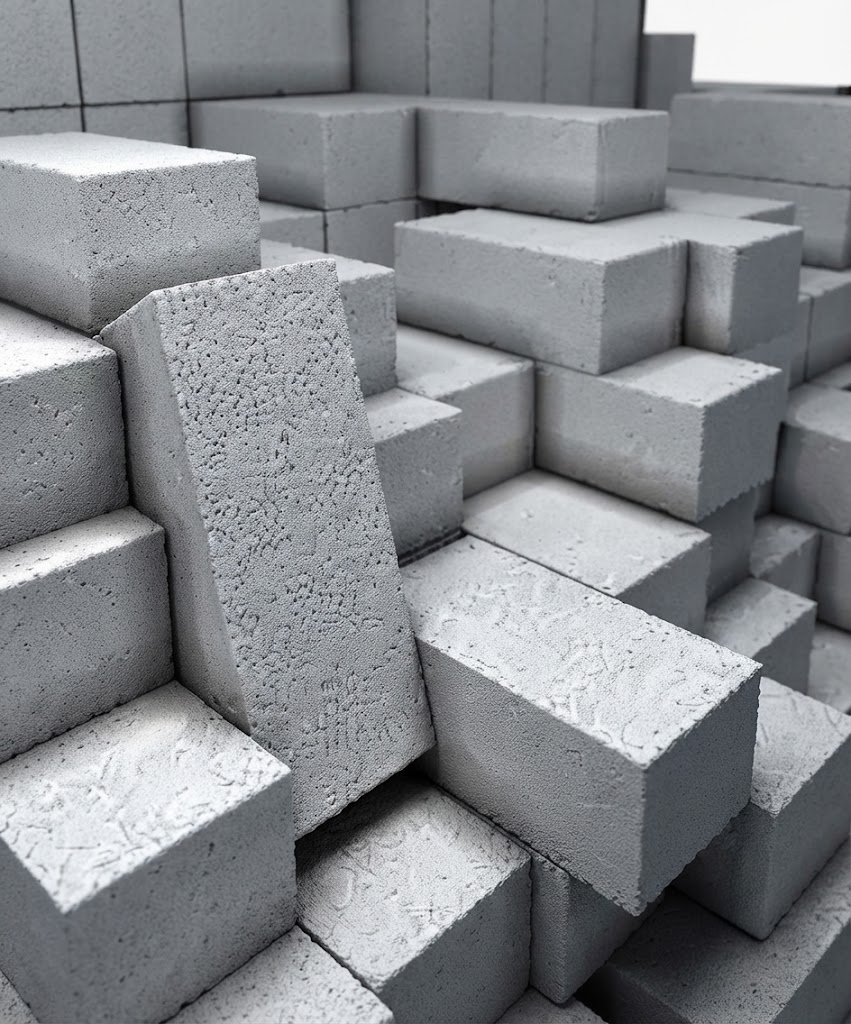
Fly ash bricks are high-quality masonry units designed as an alternative to conventional clay bricks. They offer high strength, lower weight, and better dimensional consistency.
Unlike clay bricks, which require kiln firing and consume agricultural topsoil, fly ash bricks are manufactured through controlled curing or autoclaving.
The key ingredient is fly ash, a by-product collected from coal-fired thermal power plants through electrostatic precipitators (ESPs). Its reactive silica and alumina content react with cement or lime binders to form a dense, strong matrix.
Uses 50% fly ash, 30% slaked lime, and 20% anhydrous gypsum, with 3 to 4 times as much stone dust or sand filler. The calcium oxide content supports a self-cementing reaction when water is added.
Uses 76% fly ash, 20% Ordinary Portland Cement (OPC), and 4% anhydrite, with 3 to 4 times as much filler. The fly ash reacts with calcium compounds from the cement to develop long-term strength.
Dimensions (mm) : 230 × 150 × 100
Compressive Strength : 7.5–10 MPa
Standards : IS 12894, IS 3812 Part 1, ASTM C618
Loss on Ignition (LOI): Below 5%, supporting low unburnt carbon content.
Fineness : Air-classified to comply with IS 3812 Part 1 guidelines and support pozzolanic activity.
Under the Ministry of Environment, Forest and Climate Change (MoEFCC) notification, construction projects within 300 km of a coal or lignite thermal power plant are required to use fly-ash-based building materials in masonry.
Ashtech provides compliant, certified fly ash bricks for these requirements.
Our Fly Ash Bricks are manufactured using high-quality fly ash and a controlled production process to deliver consistent strength, accurate dimensions and reliable performance.
| Ashtech Fly Ash Bricks | Regular Clay Bricks |
|---|---|
| Higher Strength Manufactured for consistent compressive strength and long-term durability. | Strength can vary depending on clay quality and firing conditions. |
| Precision Dimensions Uniform size and sharp edges reduce mortar usage and improve construction accuracy. | Size variations often require thicker mortar joints and additional plaster. |
| Lower Water Absorption Reduced water absorption helps improve durability and minimise dampness. | Higher water absorption typically requires soaking before use. |
| Smoother Wall Finish Smooth surface helps reduce plaster thickness and delivers a cleaner finish. | A rougher surface generally needs thicker plaster for an even finish. |
| Sustainable Building Material Made using fly ash, supporting productive ash utilisation while reducing dependence on natural topsoil. | Manufactured from clay, consuming natural topsoil during production. |
| Faster Construction Uniform, lightweight bricks are easier to handle, helping improve laying speed and site productivity. | Heavier, less uniform bricks can increase handling time and construction effort. |
Uniform surfaces and sharp edges help reduce gaps, lowering joint mortar and plaster consumption by up to 50%.
At approximately 2.6 kg per standard brick, the lower weight can help reduce structural steel and concrete requirements by up to 30% to 35%.
The smooth surface allows gypsum plaster to be applied directly to internal walls without a primary lime-plaster backing coat.
No 24-hour soaking is required. Simple water sprinkling before laying is sufficient.
High compressive strength helps minimise damage during handling and transportation.
A refined pore structure limits water penetration, helping reduce dampness and seepage.
Copyright © 2026 Ashtech. All rights reserved.